Breast augmentation surgery
Breast augmentation surgery can be considered with Dr. Ömer Parıldar when a patient would like to increase breast volume, restore fullness that has decreased over time or create a different breast proportion. The decision is highly individual. Some patients have naturally smaller breasts, while others notice volume loss after pregnancy, breastfeeding, weight change or ageing. The aim of consultation is to understand what you would like to change and determine which surgical approach may be suitable for your anatomy.
Breast enlargement is generally performed using implants placed beneath the breast tissue or in a selected position relative to the chest muscle. Choosing an implant involves much more than deciding on a cup size. Breast width, existing tissue, skin quality, chest dimensions, nipple position and personal expectations all influence planning.
Breast augmentation surgery should therefore be approached as an individually designed procedure rather than as a standard operation in which every patient receives the same implant or technique. Dr. Ömer Parıldar evaluates the existing breast structure and discusses the changes that may reasonably be achieved before a surgical plan is established.
Why Do Patients Consider Breast Augmentation?
Reasons for seeking breast enlargement vary considerably.
Some women have always felt that their breasts are smaller than they would prefer in relation to their shoulders, waist or hips. Others are comfortable with their natural breast size until pregnancy or substantial weight changes alter the amount of breast volume.
Pregnancy and breastfeeding can change both the skin envelope and the distribution of breast tissue. The breasts may appear less full in the upper region even when their overall size has not changed dramatically.
Weight loss can produce a similar effect. A patient may achieve the body weight she wanted but find that the breasts have lost volume along with other areas.
Natural asymmetry is another common concern. Most women have some degree of difference between their two breasts. In some cases, the difference is subtle, while in others it affects clothing choices or becomes a significant personal concern.
The purpose of augmentation is not to create identical breasts. Perfect symmetry is not realistic because natural differences in the rib cage, breast base and nipple position can remain even after surgery.
A consultation with Dr. Ömer Parıldar allows these concerns to be separated and discussed individually rather than placing every patient into the same aesthetic category.
Breast augmentation surgery: Who May Consider It?
Breast augmentation surgery may be suitable for adults who are in appropriate general health, have realistic expectations and understand both the potential changes and the limitations of the procedure.
Good surgical planning begins with identifying what you actually want to change.
A patient seeking greater upper-breast fullness has a different goal from someone concerned primarily about asymmetry. Another patient may want a moderate increase in volume without creating a noticeably augmented appearance.
Your medical history also matters. Previous breast surgery, family history, current breast symptoms, medications, smoking habits and other medical conditions should be discussed openly.
If you are planning pregnancy in the near future, it may be useful to discuss timing. Pregnancy and breastfeeding can change breast volume and skin quality after an operation, potentially altering the appearance achieved by surgery.
Stable expectations are equally important. Implant surgery changes breast volume and shape, but it cannot guarantee a particular clothing size or reproduce another person’s anatomy.
During assessment, Dr. Ömer Parıldar can discuss whether augmentation alone is likely to address the concern or whether another procedure needs consideration.
The Consultation Starts With Your Anatomy
An effective consultation does not begin with selecting an implant from a catalogue.
The width and shape of the natural breast provide important information about what can be placed safely and proportionately. Chest-wall shape, skin elasticity and the amount of existing breast tissue also influence the final appearance.
The position of the nipples is evaluated because adding volume does not automatically correct significant breast drooping.
This distinction is particularly important after pregnancy or major weight loss.
A patient may believe that a larger implant will lift the breast. While additional volume can change the breast shape, substantial sagging may require a breast lift rather than simply a larger implant.
Dr. Ömer Parıldar can assess whether volume enhancement alone is likely to meet your expectations or whether lifting should be discussed separately.
Clinical measurements also help determine which implant dimensions may fit the breast base appropriately.
The aim is not to select the largest implant that the tissues can physically accommodate. Long-term tissue behaviour and proportion are part of the decision.
Breast augmentation surgery: Implant Choices
Planning Breast augmentation surgery involves decisions about implant dimensions, projection, surface characteristics and filling material. These choices interact with one another, which is why the implant should be selected as part of the overall surgical plan rather than according to volume alone.
Two implants containing the same nominal volume can have different widths and projections. One may be broader with less forward projection, while another can be narrower and project further from the chest.
This distinction matters because every chest has different dimensions.
An implant that suits one patient may be too wide, too narrow or too prominent for another person with a different breast base.
The existing tissue also affects how the implant will look. A patient with more natural breast tissue may have greater coverage over the implant, whereas someone with very little tissue may require a different approach to implant positioning.
Patients sometimes arrive with a specific volume in mind because a friend or online photograph achieved a result they like. That information can help communicate preferences, but it should not dictate the final choice.
During your consultation, explain the appearance you prefer. Words such as subtle, fuller, proportionate or more prominent can be useful when combined with an anatomical assessment.
Implant Volume Is Not the Same as Cup Size
One of the most common questions is how many millilitres are needed to reach a particular cup size.
There is no reliable formula.
Bra sizing varies substantially between manufacturers, and cup size is influenced by chest circumference as well as breast volume.
For this reason, planning solely around a target bra label can be misleading.
It is more useful to discuss proportion and shape.
Do you want a subtle change that remains close to your natural proportions? Are you looking for noticeable upper-pole fullness? Would you prefer the breast to project further while maintaining a relatively narrow base?
These descriptions give more meaningful information than simply asking for a specific cup size.
Dr. Ömer Parıldar can combine your preference with measurements of the chest and breast to discuss a suitable range of implant dimensions.
The final choice should aim to balance your desired appearance with the characteristics of your tissues.
Where Can the Implant Be Positioned?
Implants can be positioned in different planes depending on the patient’s anatomy and the surgical approach.
One option is placement beneath the breast tissue and above the chest muscle.
Another involves positioning the implant partly or more extensively beneath the muscle.
There are also variations in technique that combine characteristics of these approaches.
The most suitable position depends on several factors, including tissue thickness, breast shape, implant choice and desired contour.
A patient with very little natural tissue may need more implant coverage than someone with a thicker breast envelope.
The position can also influence early discomfort, implant visibility and the relationship between the breast and the chest muscle.
There is no single placement that is automatically correct for every patient.
Ask Dr. Ömer Parıldar why a particular implant position is being recommended in your case and what differences you should expect from the alternatives.
Understanding the reason behind the plan is more useful than simply choosing the technique that sounds most modern.
Where Are the Incisions Made?
Breast implants require an incision through which the implant can be placed.
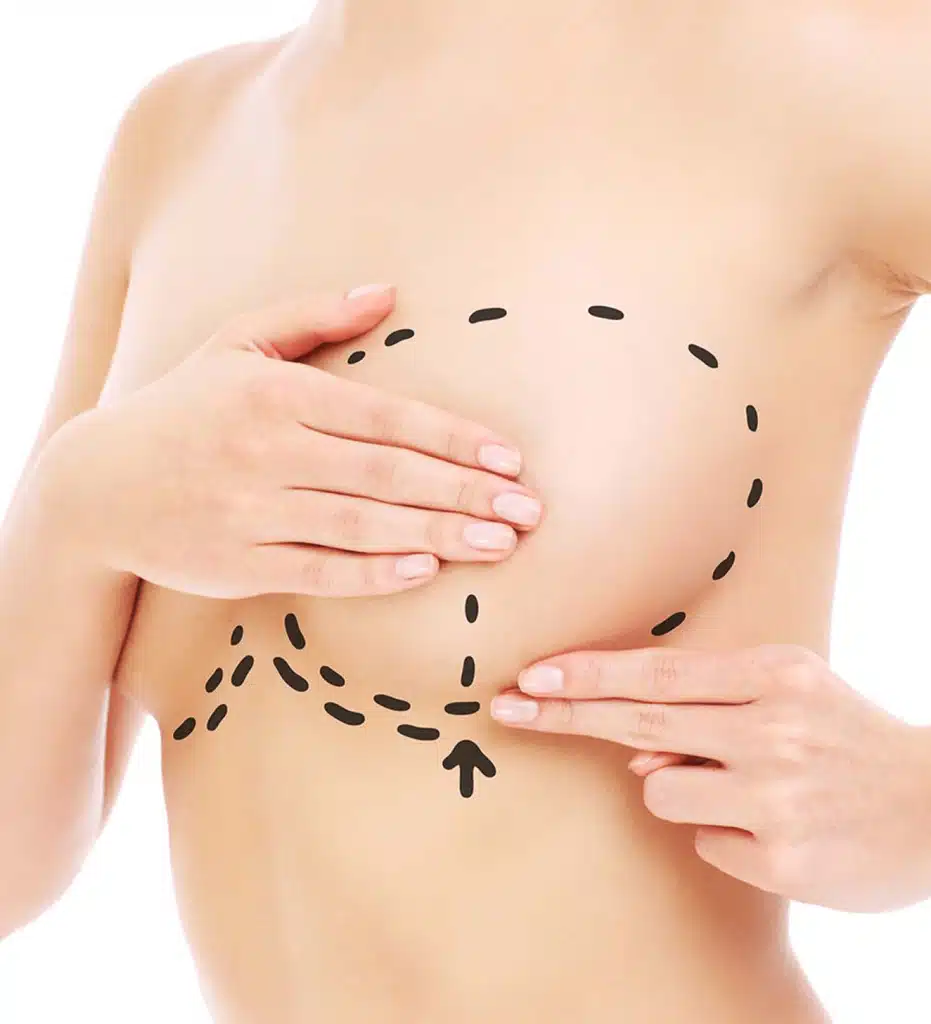
One commonly used location is the fold beneath the breast. The incision is positioned within or close to the inframammary crease and generally becomes less prominent as it matures.
Other incision approaches may be considered depending on the surgical plan and individual anatomy.
Scar appearance changes over time. During the first months, the scar can be more visible, pink or firm. It generally softens and fades gradually, although every patient heals differently.
Factors such as genetics, skin type, wound tension, infection and smoking can influence scar quality.
The scar should therefore be part of the consultation from the beginning.
Ask where the incision is expected to sit and how long it is likely to be.
A patient choosing surgery should understand that scars are permanent even when they become relatively inconspicuous.
What Happens on the Day of Surgery?
Breast enlargement is generally performed under anaesthesia in an appropriately equipped surgical environment.
Before the procedure, markings may be made while you are standing. These provide guidance about the natural breast boundaries, fold position and planned implant placement.
During surgery, an incision is made according to the selected technique.
A pocket is then created for the implant in the planned anatomical position. Careful pocket formation is important because the size and shape of this space influence where the implant sits.
The selected implants are then placed, and their position is assessed before the incisions are closed.
Dressings are applied after surgery, and a supportive surgical bra may be recommended.
The exact operative process depends on the individual plan. Patients should receive procedure-specific information during consultation rather than assuming their experience will be identical to someone else’s.
Breast augmentation surgery: Recovery
Recovery after Breast augmentation surgery usually involves temporary swelling, tightness and discomfort around the chest. The intensity varies according to individual sensitivity, implant position and surgical technique.
The breasts may initially appear higher, firmer or more swollen than expected.
This early appearance is not the final result.
As swelling decreases and the tissues gradually adapt, the implants usually settle into a more natural position.
Medication may be prescribed for postoperative discomfort. Follow the instructions provided by the surgical team rather than changing doses independently.
A supportive bra may be recommended during the early recovery period. The type of garment and how long it should be worn depend on the treatment plan.
Gentle walking is usually encouraged when medically appropriate, but strenuous exercise and heavy lifting should be avoided until healing has progressed sufficiently.
Patients should arrange help with demanding household tasks during the first days.
If you have young children, consider who can assist with lifting because repeatedly picking up a child can place unnecessary stress on the chest during early healing.
Follow-up appointments allow Dr. Ömer Parıldar to monitor incision healing, swelling and implant position.
Returning to Work and Normal Activities
The appropriate return-to-work period varies according to occupation and recovery.
A patient with a desk-based job may be able to return earlier than someone whose work requires lifting, repetitive arm movements or physical effort.
Even office work should be considered realistically.
Commuting, carrying a laptop bag, reaching overhead and sitting for long periods can feel different during early recovery.
Driving should resume only when you can control the vehicle comfortably and safely. You also need to be free from medication that could affect concentration or reaction time.
Exercise should return gradually.
Walking generally resumes before running, resistance training or upper-body exercise.
Chest training, heavy weights and movements involving forceful arm activity require specific guidance because they place greater demand on healing tissues.
Ask about the activities you actually perform rather than requesting one universal return date.
Will Implants Look Natural?
Natural appearance is influenced by much more than implant size.
The relationship between implant width, projection and the patient’s existing breast tissue has a major effect on the result.
Skin quality also matters.
A moderate implant with good tissue coverage can look different from the same implant placed in a very thin patient.
The natural shape and position of the breast before surgery remain important as well.
An implant enhances the existing anatomy; it does not completely replace it.
This is why two patients receiving implants with similar dimensions can have very different results.
During consultation with Dr. Ömer Parıldar, describe what “natural” means to you.
For one patient, it may mean a subtle increase with minimal upper fullness. Another may want a clearly fuller breast while still maintaining proportion with the chest.
Clear communication is more useful than relying on a single descriptive word.
Breast Augmentation and Breast Lifting Are Different
Patients sometimes believe that increasing implant size will correct any degree of sagging.
This is not always the case.
An implant adds volume. A breast lift changes the position and shape of the breast by removing excess skin and reshaping the tissue.
Mild laxity may sometimes be managed with augmentation alone, depending on the anatomy.
More pronounced drooping may require lifting either alone or together with an implant.
Combining procedures can involve additional scars and different recovery considerations.
During examination, Dr. Ömer Parıldar can assess the relationship between the nipple, breast fold and skin envelope.
The treatment plan should address the underlying concern rather than attempting to solve every problem simply by choosing a larger implant.
Potential Risks and Complications
All surgery involves potential risks, and breast implantation is no exception.
Early complications can include bleeding, infection, fluid accumulation, delayed wound healing and reactions related to anaesthesia.
Changes in breast or nipple sensation can occur. These may be temporary, although persistent changes are possible.
Implant-related complications can also develop.
Capsular contracture occurs when the natural scar tissue surrounding an implant becomes unusually firm and tight. This can change breast shape, create firmness or cause discomfort.
Implants can also change position over time.
Rippling, palpability, asymmetry and contour irregularities are possible, particularly when tissue coverage is limited.
Implant rupture is another consideration. Breast implants should not be considered lifetime devices, and future monitoring or additional surgery may eventually be required.
Before deciding on surgery, ask how implant-related concerns are evaluated and what circumstances could require replacement or revision.
An informed decision includes understanding the possibility of future surgery rather than viewing implantation as a one-time intervention that can never require further attention.
What About Breast Screening?
Breast health remains important after augmentation.
Tell healthcare professionals performing future breast imaging that you have implants because additional imaging views or specific techniques may be required.
Routine breast-health evaluation should continue according to your age, symptoms, medical history and recommendations from the relevant healthcare professionals.
An implant does not eliminate the need to investigate a new breast lump, unexplained pain, nipple change or other concerning symptom.
If a breast abnormality is present before elective cosmetic surgery, appropriate assessment should take place before proceeding.
During consultation, provide accurate information about previous breast examinations, imaging and family history.
Pregnancy and Breastfeeding After Augmentation
Pregnancy remains possible after breast implant surgery.
However, pregnancy and breastfeeding can alter breast size and skin quality, which may change the appearance achieved through surgery.
Some patients experience greater skin stretching, while others develop volume changes after breastfeeding.
The degree of change cannot be predicted precisely.
Breastfeeding may still be possible after augmentation, but individual ability depends on multiple factors unrelated to implants as well.
If future pregnancy is an important part of your plans, discuss timing with Dr. Ömer Parıldar.
You may decide to proceed with surgery while accepting that the breasts can change later, or you may prefer to postpone treatment.
Both approaches require an individual decision rather than a universal rule.
How Long Do Breast Implants Last?
Breast implants should not be viewed as devices that are guaranteed to remain unchanged for life.
Some patients can live with the same implants for many years without needing surgery, while others may eventually require replacement or revision because of a complication, implant change or personal preference.
There is no single calendar date on which every implant must automatically be replaced.
Long-term follow-up should focus on the condition of the implant, breast tissues and patient symptoms.
Changes in breast shape over time can also occur because the surrounding tissues continue to age.
Weight fluctuation, pregnancy and natural changes in skin elasticity may affect the breast even when the implant itself remains intact.
This long-term perspective should form part of the decision before the first operation.
Breast augmentation surgery in Istanbul
Patients considering Breast augmentation surgery in Istanbul with Dr. Ömer Parıldar should plan the process around consultation, surgery and postoperative follow-up rather than treating the operation as a short travel appointment.
If you are travelling from another city or country, explain this before scheduling treatment.
Ask how long you should remain in Istanbul after the procedure and which postoperative examinations are expected before departure.
Avoid booking a rigid return schedule without considering recovery.
You may initially have restrictions on carrying luggage, reaching overhead or performing strenuous activity.
Travelling with someone who can help with bags and transport may make the early period easier.
Before returning home, make sure you understand how follow-up will continue.
You should know which symptoms can be discussed remotely and which concerns require an in-person examination.
Keep your postoperative instructions and relevant medical information easily accessible during travel.
How Is the Cost Determined?
The cost is based on the individual surgical plan rather than breast enlargement being treated as one identical package for every patient.
The type of implant, anaesthesia, hospital requirements, surgical planning, postoperative garments and follow-up care may all contribute to the overall treatment estimate.
If a breast lift or another procedure is being considered at the same time, this can also affect the plan and cost.
Ask for a clear explanation of what is included.
You should understand whether the quotation covers implants, facility fees, anaesthesia and scheduled postoperative examinations.
Financial information becomes much more useful after the surgical plan has been established.
Choosing an implant or technique solely because it produces the lowest price does not take into account whether that option is appropriate for your anatomy.
Preparing Questions for Your Consultation
Write down your questions before the appointment.
Ask which implant dimensions are being considered and why.
Discuss implant placement and incision location.
Ask whether augmentation alone is likely to address your concerns or whether breast lifting should also be considered.
Find out how long you should expect to limit work, driving and exercise.
Ask how implants are monitored in the future and what circumstances might lead to revision surgery.
If you have photographs that represent the general proportions you like, they can help communicate preferences. They should be used as a discussion tool rather than as a promise that identical breasts can be created.
Most importantly, tell Dr. Ömer Parıldar what you do not want as well as what you hope to achieve.
This can help make the treatment discussion more precise.
Dr. Ömer Parıldar
Considering Breast augmentation surgery starts with understanding your own breast anatomy and deciding what degree of change feels appropriate for you. Implant size alone cannot determine a successful plan; breast width, tissue coverage, skin quality, symmetry and long-term expectations all need to be considered together.
Dr. Ömer Parıldar can evaluate these factors during an individual consultation and discuss the implant dimensions, placement and incision approach that may suit your circumstances.
You do not need to arrive having chosen a specific implant volume or technique. Begin by explaining the changes you want to see and the appearance you would prefer to avoid.
A carefully planned consultation gives you the opportunity to understand the operation, recovery, scars, potential complications and long-term considerations before making your decision.
Contact Dr. Ömer Parıldar
Telephone: +90 546 198 81 35
WhatsApp: +90 546 198 81 35
Email: info@dromerparildar.com
Address:
Basınköy, Florya Cd. No:15-17
34153 Bakırköy / İstanbul
Contact Dr. Ömer Parıldar to arrange an individual consultation and discuss a breast augmentation plan shaped around your anatomy, expectations and desired proportions.
İlgili bağlantı: https://www.dromerparildar.com/iletisim/
İlgili bağlantı: https://www.instagram.com/dromerparildar/
Articoli correlati
Scopri altri approfondimenti dedicati ad argomenti simili.